
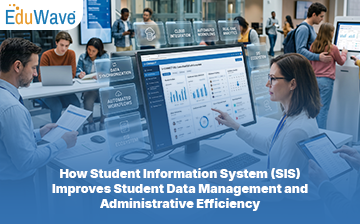
How Student Information System (SIS) Improves Student Data Management and Administrative Efficiency
Managing student data efficiently has become a critical priority for educational institutions of all sizes. Schools, universities, and training centers handle vast amounts of information every day, including enrollment records, attendance, grades, student profiles, communication logs, and compliance documentation. When this information is scattered across spreadsheets, paper files, and disconnected systems, it leads to inefficiencies, errors, duplicated work, and slow decision-making.
A Student Information System (SIS) provides a centralized digital platform that streamlines how institutions manage student data and administrative operations. By automating routine processes, improving data accuracy, and enabling real-time access to information, modern Student Information System software helps institutions operate more efficiently while improving service quality for students, parents, and staff.
In this article, we explore how a Student Information System (SIS) improves student data management and administrative efficiency, highlighting the key operational benefits and explaining why institutions increasingly rely on a robust student information to support growth, compliance, and digital transformation.
Keyways a Student Information System (SIS) Improves Efficiency
An effective SIS system transforms administrative workflows by eliminating manual processes, reducing data fragmentation, and enabling smarter decision-making across academic and operational functions.
Centralized Data Management
One of the most significant advantages of a Student Information System software is centralized data management. All student records are stored in a single, secure environment and accessed by authorized users based on defined roles and permissions.
Instead of maintaining multiple spreadsheets or physical files, administrators can access enrollment details, academic history, attendance records, disciplinary actions, and student profiles from one unified platform. This reduces duplication, minimizes inconsistencies, and ensures data accuracy across the institution.
Centralized Information also simplifies compliance and auditing. Institutions can quickly retrieve historical records, verify documentation, and maintain consistent data standards without manual reconciliation.
Key benefits include:
• A Single source of truth for all student data
• Reduced data entry errors and duplication
• Faster access to accurate information
• Improved data security and governance
Automated Attendance Tracking
Manual attendance tracking consumes valuable teaching and administrative time and often results in delayed or inaccurate records. A modern SIS system provides digital attendance tools that allow instructors to record attendance efficiently based on registered class lists.
Attendance data is automatically reflected in student profiles and administrative reports, while rule-based alerts can be triggered according to institutional policies. Administrators can monitor attendance trends and compliance without manual consolidation.
Automation reduces administrative workload while improving accountability and data reliability.
Efficiency gains include:
• Faster attendance recording
• Automated alerts based on defined rules
• Reduced manual data processing
• Improved accuracy and consistency
Streamlined Communication
Effective communication between students, parents, teachers, and administrators is essential for smooth operations. Student Information System software centralizes communication channels, allowing institutions to share announcements, notifications, academic updates, and reminders through integrated portals and communication tools.
Instead of relying on fragmented emails or disconnected messaging platforms, stakeholders access consistent information through the SIS system. Documented communication history improves transparency and traceability across the organization.
A centralized communication layer enhances responsiveness, reduces miscommunication, and strengthens engagement with students and families.
Common improvements include:
• Automation
• Reporting for decision making
• Unified messaging across departments
• Faster dissemination of announcements and updates
• Improved parent and student engagement
• Documented communication history
Efficient Scheduling
Scheduling classes, exams, rooms, and instructors becomes increasingly complex as institutions scale. A Student Information System (SIS) supports scheduling management through centralized scheduling tools that help institutions organize academic calendars, master schedules, and examination sessions.
Authorized users can generate schedules, manage conflicts, and apply institutional rules to ensure balanced workloads and optimized resource usage. Schedule updates propagate are automatically reflected across the system.
Efficient scheduling reduces operational friction and improves utilization of facilities and staff.
Key benefits include:
• Centralized schedule management
• Automated conflict detection and resolution
• Faster updates when schedules change
• Improved resource utilization
Real-Time Data Access
Timely access to information enables faster decisions and better operational control. A modern SIS system provides dashboards and reports that display enrollment data, attendance trends, academic performance, and operational indicators.
Decision-makers can monitor key metrics without waiting for manually compiled reports, while teachers and administrators can access up-to-date student profiles and performance data when needed.
Near real-time visibility supports proactive management and improves institutional responsiveness.
Advantages include:
• Instant access to operational metrics
• Faster decision-making
• Improved responsiveness to risks and opportunities
• Reduced reporting delays
Improved Record Keeping
Educational institutions must maintain accurate records over long periods to meet regulatory, accreditation, and operational requirements. A Student Information System software digitizes record keeping and ensures consistent data retention across academic cycles.
Documents such as transcripts, enrollment history, disciplinary records, and student profiles are stored securely and indexed for efficient retrieval. Role-based access controls ensure confidentiality and compliance with governance policies.
Digital record keeping improves operational resilience and reduces physical storage dependency.
Efficiency gains include:
• Faster document retrieval
• Reduced paper storage and archiving
• Improved compliance readiness
• Enhanced data security
Integration with Other Systems
A powerful Student Information System (SIS) integrates with other digital platforms such as Learning Management System (LMS), assessment platforms, communication tools, and institutional systems through open standards and APIs.
Integration reduces duplicate data entry and ensures consistency across platforms. Academic data flows seamlessly between learning environments and administrative systems, improving accuracy and operational continuity.
System interoperability strengthens scalability and long-term digital maturity.
Key advantages include:
• Reduced duplicate data entry
• Consistent data across platforms
• Automated data synchronization
• Improved scalability
Reporting and Analytics
Data-driven decision-making is essential for institutional performance and strategic planning. An advanced SIS system, combined with analytics platforms such as EMIS, provides extensive reporting capabilities, dashboards, and statistical analysis tools.
Administrators can generate operational reports, performance indicators, enrollment trends, and academic insights at school, district, and organizational levels. Reports can be customized, filtered, exported, and shared according to authority levels.
A well-designed student data management system supports continuous improvement and evidence-based planning.
Benefits include:
• Automated report generation
• Graphical dashboards and KPIs
• Drill-down analysis across multiple levels
• Improved transparency and accountability
Conclusion
A modern Student Information System (SIS) is far more than a digital database. It is a foundational operational platform that strengthens how institutions manage student data, streamline administrative workflows, and enable scalable growth.
By centralizing data, automating attendance, improving communication, optimizing scheduling, supporting accurate fee management [DH3.1], enabling near real-time visibility, strengthening record keeping, integrating systems, and expanding analytics capabilities, a robust Student Information System software drives measurable efficiency across educational operations.
Institutions that invest in a secure, scalable SIS system benefit from reduced administrative workload, improved data accuracy, faster decision-making, and stronger engagement with students and families. As education continues to evolve in a digital-first environment, an integrated student data management system becomes a critical foundation for operational excellence, governance readiness, and long-term institutional resilience.
Selecting the right SIS platform is therefore not only a technology decision, but a strategic investment in sustainable educational performance.